As an educator who has worked in China for more than a decade, I often hear a common phrase:
“We need to teach critical thinking.”
And every time I hear it, I find myself asking a different question.
Can critical thinking actually be taught?
Or is it something that develops naturally when students are placed in the right learning environment?
Before discussing China, it is worth defining what critical thinking actually means.
Educational philosopher Robert Ennis defined critical thinking as:
“Reasonable and reflective thinking focused on deciding what to believe or do.”
In simple terms, critical thinking is the ability to analyze information, evaluate evidence, consider different perspectives, and make reasoned judgments.
It is not about disagreeing with everything.
It is not about challenging authority for the sake of challenging authority.
It is about thinking carefully before reaching conclusions.
When discussing critical thinking in China, many educators immediately point to Confucianism. I have often heard comments such as:
“Students are taught to listen rather than question.”
“Teachers are seen as authorities whose views should not be challenged.”
Whether these perceptions are accurate or not, they raise an interesting question about the relationship between culture, education, and critical thinking.
For more than two thousand years, Confucian thought has influenced Chinese society, emphasizing respect for learning, social harmony, personal responsibility, and clearly defined social relationships.
In Confucian thought, different roles carry different responsibilities: teachers guide, students learn, parents care for children, and leaders serve society. These relationships help create order and social stability.
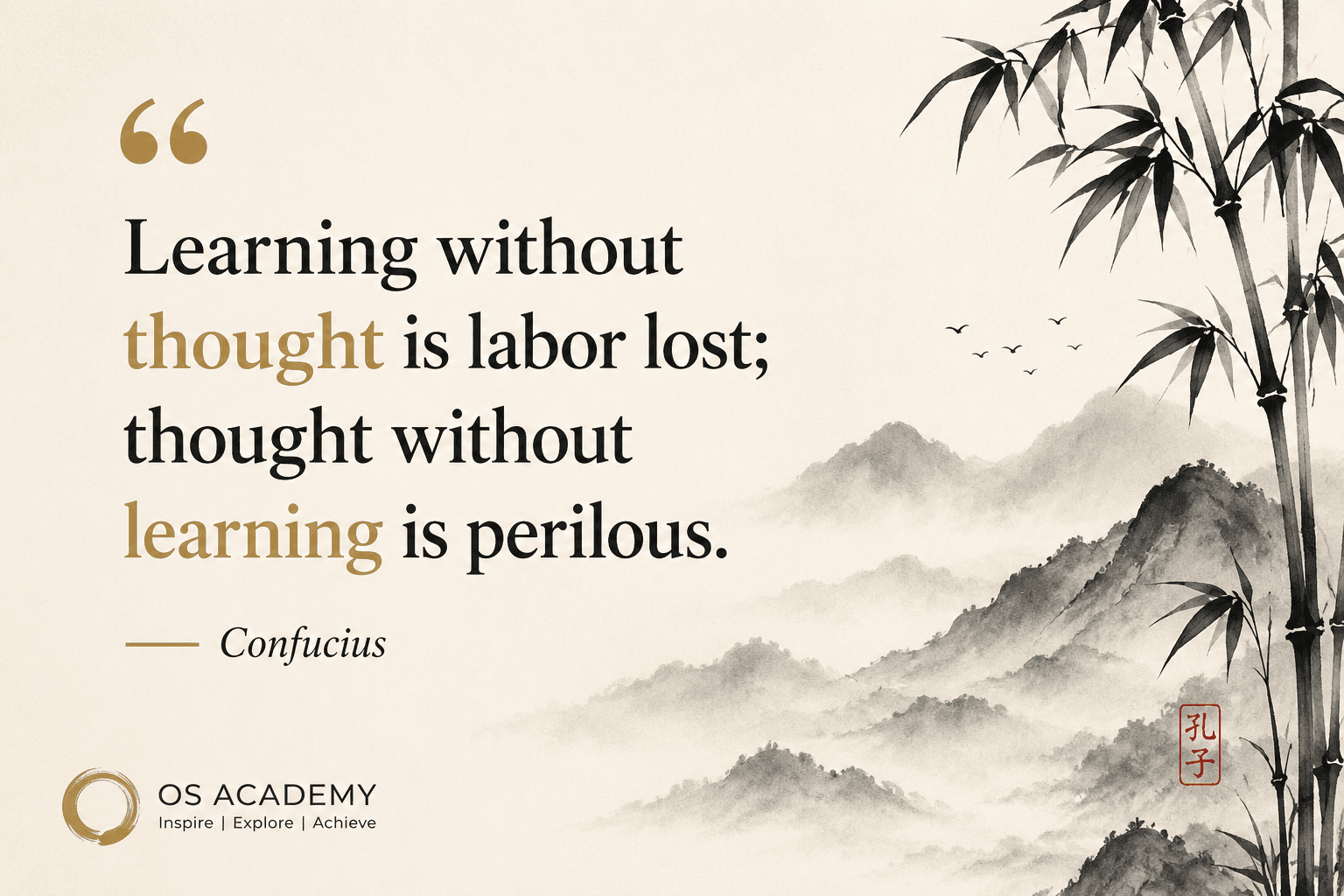
However, Confucius himself famously wrote:
“Learning without thought is labor lost; thought without learning is perilous.”
I find this quote particularly interesting because it challenges a common stereotype. If reflection and thought were already considered essential in Confucian philosophy, is the challenge really cultural? Or is it educational?
This question is fascinating because it assumes there is a conflict between traditional values and independent thinking.
But is there really?
Many people associate Confucian traditions with respect for authority, social harmony, and established hierarchies. In classrooms, this can sometimes be reflected in teacher-centered instruction, clear expectations, and an emphasis on correct answers.
Western education, on the other hand, often emphasizes questioning, debate, discussion, and challenging ideas.
At first glance, these approaches may seem incompatible.
However, after years of teaching students in China, I have come to a different conclusion.
Key Reflection
The challenge is not that students cannot think critically. The challenge is that many students have had fewer opportunities to practice critical thinking openly.
Critical thinking is not a personality trait. It is a skill.
Just as students learn mathematics through practice, they learn critical thinking through repeated opportunities to analyze information, evaluate evidence, compare perspectives, and justify their opinions.
In my experience, Chinese students are often exceptionally capable of critical thought when given the right environment and time.
When discussions are structured, expectations are clear, and students feel psychologically safe, they can ask insightful questions, identify weaknesses in arguments, and propose creative solutions.
The issue is often not ability - it is habit.
Many educational systems around the world, not only in China, still reward finding the correct answer more than exploring alternative possibilities.
As educators, our task is not to replace cultural values. It is to build upon them.
Respect for teachers does not prevent critical thinking.
Discipline does not prevent creativity.
Academic rigor does not prevent innovation.
I believe the strongest educational systems of the future will not be those that choose between Eastern and Western approaches, but those that understand how to combine the strengths of both.
The perseverance, discipline, and respect for learning often associated with Confucian traditions have helped generations of students achieve remarkable academic success.
At the same time, inquiry, creativity, collaboration, and analytical thinking have become increasingly important in a world shaped by rapid technological and social change.
Perhaps the future of education lies not in replacing one philosophy with another, but in understanding how these traditions can complement each other.
The goal is not to choose between discipline and creativity, respect and inquiry, structure and independence.
The goal is to develop learners who are capable of both.
What are your experiences teaching or learning critical thinking across different cultures?